




Solar Mounting Structure Price in India 2026: Cost per Watt, Mini Rail vs Full Rail and Complete Buyer’s Guide
Date: 24-07-2026 | Author: Sugatu
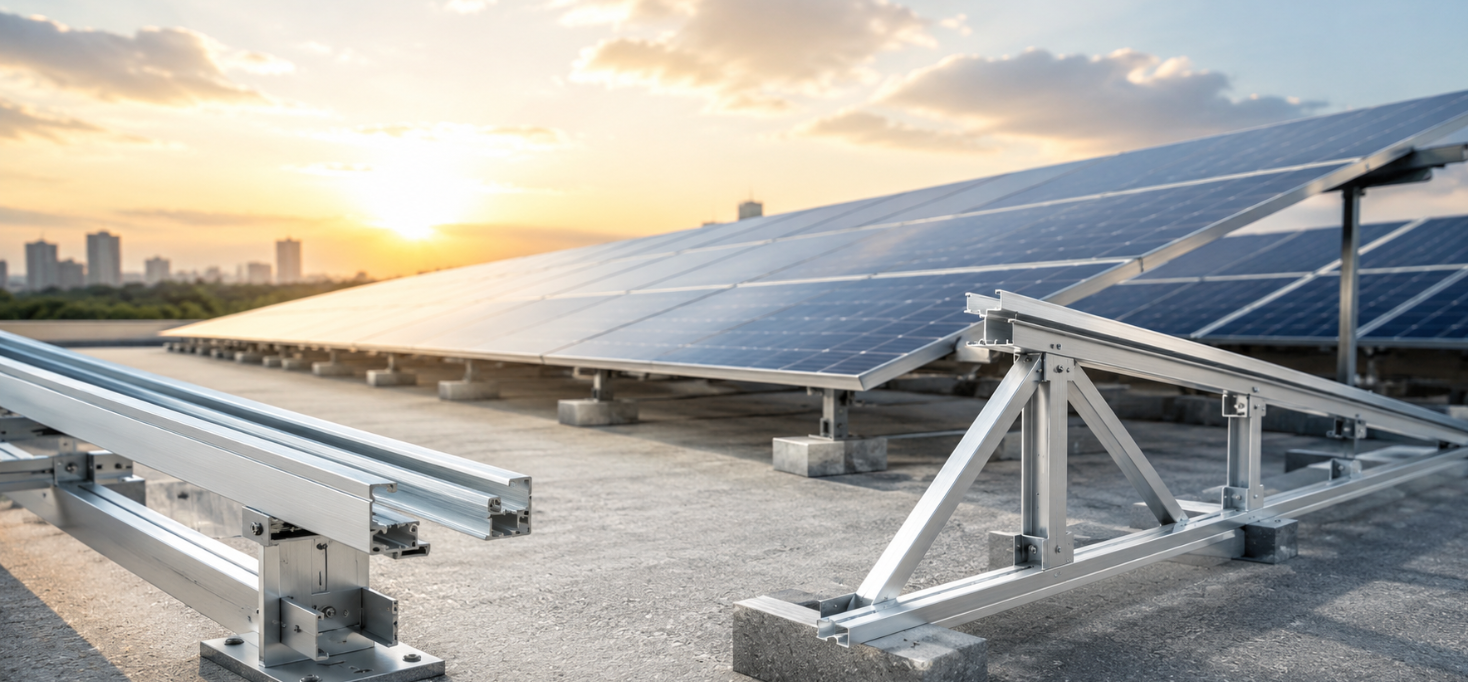
The solar mounting structure price in India in 2026 generally begins in a broad indicative range of approximately ₹2 to ₹6 per watt for many standard rooftop applications. This means that the structure-only budget for a 100 kW rooftop solar project may start at roughly ₹2 lakh and can extend beyond ₹6 lakh, depending on the material, roof type, wind-load requirement, rail system, coating thickness, installation method and project location. Elevated RCC structures, high-wind designs, coastal projects, solar carports, customized industrial systems and ground-mounted projects can cost considerably more. These figures are planning benchmarks, not fixed quotations, and may exclude GST, freight, installation labour, civil work, waterproofing, testing, walkways, safety lines and other accessories.
India’s solar market has moved from rapid adoption to large-scale infrastructure development. The Ministry of New and Renewable Energy reported 162.15 GW of cumulative solar capacity as of 30 June 2026, including 30.11 GW of grid-connected rooftop solar. As rooftop, commercial, industrial and utility-scale projects expand, buyers are paying closer attention to the component that physically protects the modules for their full working life: the solar mounting structure. A panel may generate the electricity, but the mounting system carries the load, controls the tilt, resists wind forces, protects the roof and keeps the array aligned for decades.
For EPC contractors, industrial project owners, solar installers, distributors and procurement teams, the correct question is not simply, “What is the cheapest solar structure?” The better question is, “What structure provides the lowest safe lifecycle cost for this roof, location and project design?” This guide explains how solar mounting structures are priced, why quotations differ, when mini rails or L-bracket full rails are more suitable, and how to compare suppliers without compromising structural safety or long-term performance.
What Is the Solar Mounting Structure Price per Watt in India?
For preliminary budgeting, many standard rooftop solar mounting systems can be considered within an indicative range of about ₹2 to ₹6 per watt. At the lower end are simple, low-profile systems with optimized material consumption, repetitive layouts and easy roof access. At the higher end are heavier rails, thicker sections, complex anchoring, elevated arrangements, customized spans, higher corrosion protection, difficult transportation and stricter wind-load requirements. The final price may be quoted per watt, per kilowatt, per kilogram, per rail, per module, per set or as a complete project package.
A per-watt quotation is useful for quick comparison, but it can also hide important differences. Two suppliers may quote the same price per watt while offering different aluminium grades, steel thicknesses, fastener quality, coating systems, rail lengths, clamp designs or engineering support. A technically complete quotation should clearly state what is included, which assumptions were used and which site conditions could change the final cost.
How Much Can a Solar Structure Cost for Different Project Sizes?
Using the broad ₹2 to ₹6 per watt planning range, a 10 kW structure may be budgeted at approximately ₹20,000 to ₹60,000, while a 50 kW structure may fall around ₹1 lakh to ₹3 lakh. A 100 kW project may require roughly ₹2 lakh to ₹6 lakh for the mounting structure, and a 500 kW project may require approximately ₹10 lakh to ₹30 lakh. These simple calculations are useful only for an initial estimate. A final engineered quote may move outside these ranges because large projects can benefit from volume efficiency, while difficult roofs, elevated designs, high wind zones, coastal exposure or extensive safety requirements can increase the cost.
The structure price should also be separated from the cost of installation. Labour, lifting equipment, transport, civil foundations, chemical anchoring, waterproofing, roof strengthening, safety systems and testing are not always included in a material quotation. Buyers should therefore compare the total installed scope rather than choosing a supplier based on one headline number.
Why Does Solar Mounting Structure Pricing Vary So Much?
Solar structures are not universal products. The same 100 kW module capacity can require very different quantities of metal and hardware depending on the roof geometry and engineering design. A low-slope metal sheet roof may use compact mini rails, while another roof may need full rails supported by L-brackets. An RCC roof may require ballast blocks, penetrating anchors or an elevated frame. A ground-mounted project may require piles, columns, rafters, purlins, bracing and extensive civil work. Each arrangement has a different material weight, manufacturing process and installation method.
Price is also influenced by aluminium and steel market rates, order quantity, project location, section thickness, anodizing or galvanizing, fastener grade, clamp design, wind speed, module dimensions, roof condition, row spacing, portrait or landscape orientation and required service life. A customized system developed after a structural assessment will normally cost more than an off-the-shelf arrangement, but it can reduce risk, avoid roof damage and provide better lifecycle value.
Mini Rail vs L-Bracket Full Rail: Which System Costs Less?
Mini rail systems are widely used on suitable trapezoidal and metal sheet roofs because they reduce rail length, lower material consumption and simplify installation. Short aluminium sections are fixed at planned points beneath the module frame, and mid clamps and end clamps secure the panels. When the roof profile, screw location, sheet thickness and structural support are compatible, mini rails can offer a fast and economical solution for repetitive industrial rooftops.
An L-bracket full rail system uses continuous or longer aluminium rails supported by L-brackets fixed to the roof structure. The longer rail provides a continuous mounting line, more flexibility for module positioning and better adjustment where the roof layout or purlin spacing requires it. Full rail systems generally use more aluminium and more supporting hardware than mini rails, so their material price may be higher. However, the extra cost can be justified when alignment, load distribution, roof geometry, access or long-term adjustability makes a continuous rail more suitable.
The cheapest system is therefore not automatically the correct system. Mini rails can reduce cost and installation time on compatible roofs, while full rails can provide better flexibility and structural continuity for other applications. The selection should be based on roof type, purlin location, fixing method, module size, wind load and the engineer’s approved layout rather than on price alone.
How Material Choice Changes the Price
Aluminium is popular for rooftop mounting because it combines low weight, corrosion resistance, clean appearance and ease of handling. Aluminium rails, mini rails, L-brackets, mid clamps and end clamps can reduce the load added to an industrial roof and can speed up installation. The price depends on alloy, temper, profile geometry, section weight, finish and order quantity. A lower-priced profile is not necessarily equivalent if it uses less metal or has lower structural capacity.
Pre-galvanized steel and galvanized iron are commonly used where cost efficiency and structural strength are priorities. They can be suitable for purlins, channels and supporting members, but the coating specification, cut-edge protection and site environment must be considered. Hot-dip galvanized steel is often selected for demanding outdoor and ground-mounted applications because the finished component receives a protective zinc coating after fabrication. It is heavier than aluminium and may increase transport and handling requirements, but it can provide strong mechanical performance for large structures.
Galvalume combines aluminium, zinc and silicon in a protective coating and is used in several roofing and solar access applications. Its corrosion behaviour and cost can make it suitable for specific components, but the complete system must be evaluated rather than judging a material by its name alone. Section thickness, coating mass, manufacturing quality, drainage, dissimilar-metal contact and local exposure all influence durability.
How Roof Type Affects Solar Structure Cost
Metal sheet roofs often provide the most economical path when the roof profile and supporting purlins are suitable for a direct-fix mini rail or full rail system. The cost can rise when roof sheets are thin, purlin locations are irregular, waterproofing requires additional treatment or access is difficult. Standing seam roofs may use non-penetrating seam clamps, which can protect the roof from drilling but require the correct clamp geometry and verified seam compatibility.
RCC roofs allow several mounting approaches, including ballasted structures, anchor-fixed frames and elevated structures. A basic low-height RCC system may be economical, while an elevated structure designed to preserve usable roof space can require more steel, bracing, foundations and engineering. The higher initial cost may create additional value by allowing maintenance access, rooftop use or better module clearance.
Industrial shed roofs require particular attention to the load path. The mounting system must transfer forces through the roof sheet and into the purlins or primary structure without creating leakage, deformation or concentrated stress. A quotation based only on module quantity, without roof drawings or a site assessment, should be treated as preliminary.
Ground-mounted solar structures are priced differently because the scope can include foundations, piles, columns, rafters, purlins, bracing, module clamps and site-specific corrosion protection. Soil conditions, terrain, table size, row spacing, tilt angle, module configuration and pile-driving access can materially change the budget. Solar carports are even more project-specific because the structure must provide vehicle clearance, drainage, architectural finish and safe foundations while supporting the PV array.
Wind Load Is a Price Factor, Not an Optional Extra
Wind creates uplift, downward pressure and lateral forces on a solar array. The force is not uniform across the roof; edge and corner zones can experience higher pressure than internal areas. A structure designed only from an average wind speed or a standard material quantity may be under-designed for the actual building. Correct engineering can require additional fixing points, stronger sections, shorter spans, more bracing or different clamp arrangements, all of which influence price.
Project owners should ask whether the quotation is based on the actual site location, building height, roof geometry, module size, tilt and mounting zone. A supplier that requests structural information before finalizing the price is usually reducing uncertainty rather than making the process complicated. The cost of appropriate engineering is small compared with the potential loss caused by module movement, roof damage or structural failure.
Corrosion Protection and Service Life
A solar power plant is expected to operate for decades, so the mounting structure must survive continuous exposure to sunlight, rain, dust, industrial pollutants, humidity and temperature variation. Coastal and chemically aggressive environments may require stronger corrosion protection than inland locations. Aluminium finish, galvanizing thickness, fastener coating and contact between dissimilar metals can all affect long-term behaviour.
A low quotation may be achieved by reducing section thickness or coating quality, but the saving can disappear if components corrode, loosen or require replacement. Buyers should compare the expected service life and warranty conditions, not just the purchase price. The best-value structure is the one that remains stable, aligned and maintainable throughout the operating life of the solar plant.
What Is Included in a Complete Rooftop Solar Mounting System?
A complete rooftop system may include mini rails or full rails, L-brackets, roof clamps, base plates, mid clamps, end clamps, rail joiners, module fasteners, self-drilling screws, EPDM sealing elements, cable clips, bonding components and other accessories. Depending on the project, it may also require walkways, cable trays, safety lines, handrails and skylight protection. These safety and maintenance components are sometimes excluded from the mounting quotation even though they are essential for safe long-term operation.
The bill of materials should identify the quantity and specification of every major component. A vague “complete structure” description makes it difficult to compare suppliers and increases the risk of variation claims later. Procurement teams should request drawings, component specifications, included fasteners, finish details, packing method, delivery terms and installation responsibilities before issuing an order.
Hidden Costs That Buyers Often Miss
Freight can be significant because rails and steel members are long and bulky. Packaging, unloading, local movement and rooftop lifting may also add cost. Cut lengths that do not match the module layout can increase wastage, while poor packing can damage anodized or coated surfaces. A supplier with optimized cut planning and project-wise packing may offer a higher unit price but a lower delivered and installed cost.
Waterproofing is another commonly missed item. Penetrating roof fixings may require approved sealing components and careful installation. On RCC roofs, anchor locations and civil work must be coordinated with waterproofing layers. Repairing leakage after commissioning can be expensive and disruptive, so the sealing method should be part of the original design and quotation.
Maintenance access also has a financial value. A tightly packed array without walkways or safe access can make cleaning, inspection and fault repair slower and riskier. Including solar walkways, cable management and fall-protection systems at the design stage may increase the initial budget, but it can reduce maintenance time, protect the roof and improve worker safety throughout the project life.
How to Compare Solar Mounting Structure Quotations
Start by confirming that every supplier is pricing the same module layout, roof type, tilt, orientation, wind criteria and scope. Compare the total system weight, section dimensions, material grade, coating or finish, fastener specification, clamp quantity, support spacing and accessories. Ask whether engineering drawings, calculations, packing, freight, installation supervision and warranty are included.
A very low price per watt may result from a lighter bill of materials, fewer fixing points or exclusions that appear later. A higher quotation may include stronger sections, better coating, complete fasteners, project drawings and optimized packing. The correct comparison is therefore cost for an equivalent technical scope, not simply the lowest number in the final column.
Buyers should also evaluate the supplier’s ability to maintain quality across the full order. Dimensional consistency, hole alignment, clamp fit, finish quality and packing affect installation speed. A small saving in material can be lost quickly if installers must rework components, wait for replacements or correct alignment on the roof.
Can a Better Mounting Design Reduce Total Project Cost?
Yes. Cost reduction should begin with engineering optimization rather than uncontrolled material reduction. Standardizing module orientation, matching rail lengths to the layout, reducing unnecessary joints, using pre-engineered components and planning fixing locations can lower material and labour requirements. Mini rails can reduce aluminium use on suitable roofs, while pre-assembled or accurately fabricated components can reduce installation time.
Early coordination between the EPC contractor, structural engineer and mounting supplier can also prevent expensive changes. When module dimensions, roof drawings, purlin spacing and cable routes are confirmed before manufacturing, the bill of materials can be optimized and site wastage can be reduced. The most economical project is usually the one with fewer surprises during installation.
Why the Lowest Solar Structure Price Can Become Expensive
Mounting structures represent a limited portion of the complete solar project cost, but they support the full value of the modules and affect the building below. Failure can damage panels, cables, connectors, roofing sheets and nearby property. Even without a major failure, loose clamps, corrosion, misalignment and water leakage can create recurring maintenance expenses and plant downtime.
Choosing the lowest-priced structure without verifying engineering and material quality can therefore create a false economy. A dependable mounting system should provide adequate strength, corrosion resistance, correct module clamping, secure roof attachment, installation efficiency and clear technical documentation. Lifecycle value is more important than the initial saving of a few paise per watt.
Why Choose Sugatu for Solar Mounting Structures?
Sugatu supplies solar mounting products and balance-of-system solutions for residential, commercial, industrial and ground-mounted projects across India. The portfolio includes aluminium mini rails, L-bracket full rail systems, mid clamps, end clamps, rooftop structures, ground-mounted structures, solar walkways, cable management products, fall-protection safety lines, handrails, skylight protection systems, MC4 connectors and related accessories.
The objective is to help EPC contractors, installers, industries and project developers source compatible components through a dependable procurement partner. By considering roof type, module layout, installation method, corrosion exposure and project scale, Sugatu can support customers in selecting a solution that balances cost, installation speed and long-term reliability.
Frequently Asked Questions
What is the average solar mounting structure price per watt in India?
For initial planning in 2026, many standard rooftop solar mounting systems may fall within a broad indicative range of approximately ₹2 to ₹6 per watt. Customized elevated, high-wind, coastal, carport and ground-mounted systems can cost more. Final pricing requires project drawings and technical specifications.
How much does a solar mounting structure cost for 100 kW?
Using a broad planning range of ₹2 to ₹6 per watt, the structure-only budget for a 100 kW project may be approximately ₹2 lakh to ₹6 lakh. This estimate may exclude GST, freight, installation, civil work, waterproofing, walkways, safety systems and engineering services.
Which is cheaper: mini rail or full rail?
Mini rail is often less expensive on compatible metal roofs because it uses shorter aluminium sections and can reduce installation time. An L-bracket full rail system normally uses more rail and hardware, but it can provide better alignment flexibility and may be necessary for certain roof layouts and load conditions.
Is aluminium or galvanized steel better for solar mounting?
Neither material is universally better. Aluminium is lightweight, corrosion resistant and convenient for rooftops. Galvanized or hot-dip galvanized steel can provide strong structural performance for heavy-duty and ground-mounted applications. The correct choice depends on load, environment, roof capacity, design life and budget.
Does the solar structure price include installation?
Not always. Some quotations cover only fabricated materials and fasteners, while others include freight, installation or supervision. Buyers should request a detailed scope stating whether labour, lifting, civil work, anchoring, waterproofing, testing and safety systems are included.
Why do two suppliers quote different prices for the same capacity?
The suppliers may be using different section weights, materials, coatings, fixing intervals, rail systems, fasteners, engineering assumptions or included accessories. Capacity alone is not enough to compare quotations. The complete technical scope and bill of materials must be reviewed.
What information is needed for an accurate quotation?
An accurate quotation normally requires project capacity, module make and dimensions, module orientation, roof type, roof drawings, purlin spacing, building height, site location, desired tilt, corrosion environment, installation method and any walkway, cable management or fall-protection requirements.
How long should a solar mounting structure last?
A properly designed and protected mounting structure should be selected for the long operating life of the solar plant. Actual durability depends on material grade, coating quality, environment, installation workmanship, drainage and maintenance. Warranty terms should be reviewed together with the technical specification.
